Claude, You Know What to Do. Bother Me Less.
My part is direction and gates.
The agent's part is everything else.
For any given project, I typically run a single orchestrator agent that itself runs two to fifteen worker agents. At some point I realized the orchestrator was stopping to ask me way too many questions. So we worked out an approach together that pushed its autonomy as far as we could – both on its own and for every worker. Below is what that looks like, and I'm always looking for ways to push it further.
Last weekend I shipped voice mode updates to Cmd+Ctrl on both Android and iOS. Here's every kind of thing I said to my orchestrator agent along the way:
- What to build. "Add a mute." "Make the mic button red."
- Feedback on how it felt. "The haptic buzz should be shorter. Match Android." Then: "I want the two shorts to have a smaller gap between them."
- What was wrong. "Up to a full second before voice mode shows it's on."
- Yes to its plan. "Yes, do all."
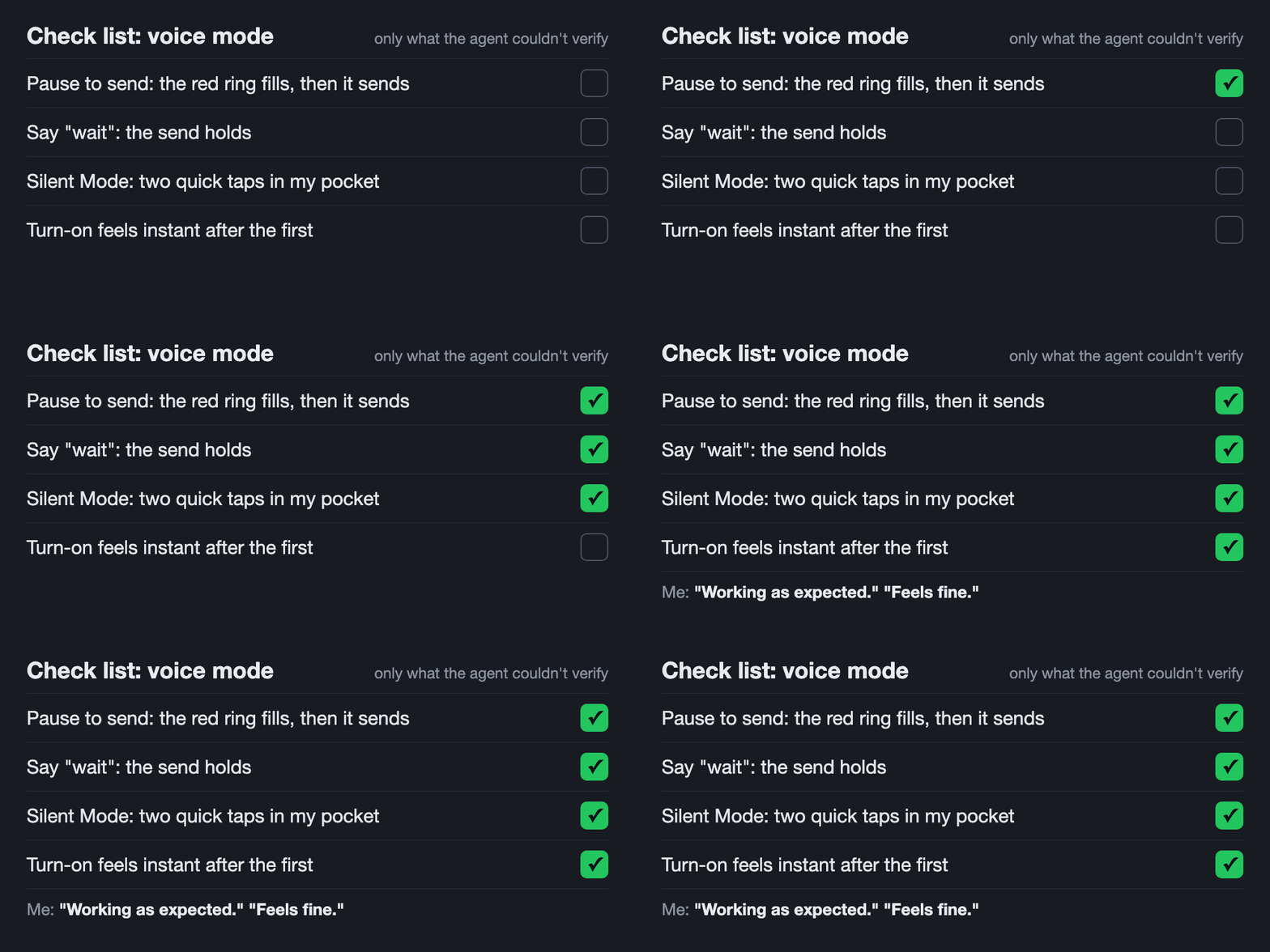
- Validation on my phone. "Working as expected." "Feels fine."
- The gates. "Push, merge and submit it."
That's it. The code, the tests, other agents refuting it, the version bumps, the release notes, the store uploads – it did all of that without me. At one point I asked it what it even needed me for. Its answer: just to hit submit.
That's the rule it runs on now: bother me only when you're sure you need me. Not "if you're stuck", not "if it might be nice to check" – truly certain. It took a few weeks of pushing to get there and still have it adhere to my standards.
Rules that get it to do more
I set a handful of rules so the agent would do more on its own.
Write down the gates – and only the gates. Push, merge, deploy, publish. Each needs my word, and approving one never implies the next. Everything else – committing on its own branch, restarting dev services, querying the database, spinning up sub-agents – is reversible and reaches nobody, so the agent just does it. An agent unsure where its permission ends will ask. Instead, tell it ahead of time.
"Blocked on you" is a dubious claim, not a fact. One task sat in my queue for days marked as "waiting for input". When I pushed on it, my part was thirty seconds and not a dependency for the rest of the work. Now the agent names the one step that truly needs me and does everything around it first.
A side question shouldn't pause the work. In one instance, the agent finished a fix step and then I asked about something else. It then followed my question for the rest of the session. Verification of the in-progress fix sat untouched for ten hours while I was at a football game. It never refused – it just never came back. Now, owed work runs first, or in the background alongside my question.
Don't hand me your own step. It once wrote a prompt for me to pass along to another agent. That's not a question for me. That's the agent's job, and I don't need to be involved.
Rules that keep it right
Autonomy without proof often just means arriving at the wrong answer faster.
Run the real thing. A daemon feature once passed its build and 22 unit tests, and the agent claimed it was ready for me to publish. The first real end-to-end run – daemon to server to an actual session to the app – showed an empty menu on every session. It would have shipped broken to every user of that agent. A worker's report is evidence, not proof.
A fresh agent must refute any set of changes. This is the rule from Refute, Don't Review, and it's what lets me trust the agent with everything else. Don't ask an agent to review the work – it reads the code and agrees with it. Tell it the code is broken and to prove it. Keep running fresh refuters while each round finds less than the last. That loop is why I can stay out of the middle: by the time anything reaches me, the agents have already argued it out.
Know when to stop. One feature went through 22 refutation rounds, each finding a narrower edge case while the launch slipped. Fix what a normal user hits. Log the rest.
What comes back to me
At the end of an agent's autonomous run, what comes back to me is not a status report. I don't need to know what it did – I know because I asked. All I need is a short check list of what it couldn't verify itself: a buzz in my pocket, a chime I have to hear, whether the feature feels right. If it runs past about six rows, it stopped verifying too early.
When decisions are still open, the agent lists them with its recommendation. A menu just hands the prioritising back to me.
Steal this
## Bother me only when you're sure you need me
- Gates: push, merge, deploy, publish. Each needs my explicit word.
  Everything else that is reversible, just do.
- Before saying "blocked on the user", name the smallest step that truly
  needs a human. Do everything around it first.
- A new question from me doesn't pause owed work. Run it first or in
  the background.
- Never hand me a step that is yours, such as writing a prompt for
  another agent.
- A report or a green test suite is evidence, not proof. Exercise the
  real end-to-end path before calling anything ready.
- Refute, don't review: tell a fresh agent the work is broken and to
  prove it. Repeat while rounds converge. Fix what normal use hits; log
  edge cases and stop.
- Hand back a check list of only what you couldn't verify, including
  whether it feels right. When decisions are open, list them with your
  recommendation – never a bare menu.
When the agent finally does reach out, it should find me wherever I am – and that is what Cmd+Ctrl is for.
I hope you find this useful.
-- Michael